Alibaba vs Sourcing Agents: What Most Buyers Get Wrong
If you’ve spent any time sourcing products internationally, you’ve probably started on Alibaba. Most people do. It’s massive, it’s fast, and it feels safe because everyone else is using it too.
But a year in, many small and mid-sized importers hit the same wall: inconsistent quality, suppliers who ghost after the first order, no real accountability when a shipment arrives wrong. At that point, the search usually begins – is there something better than Alibaba?
The honest answer: it depends on what you’re actually trying to solve.
What Alibaba is genuinely good at
Let’s be fair. Alibaba is excellent for discovery. If you need to understand what’s available, what ballpark pricing looks like, or how many manufacturers exist for a product category — it’s hard to beat. The sheer volume of listings is a real advantage when you’re in early research mode.
The platform also has a low barrier to entry. You don’t need to know anyone. You don’t need to travel. You can request samples in twenty minutes.
Where it starts to break down
The problem isn’t Alibaba itself – it’s the model. Alibaba is a directory. It connects you to suppliers, but what happens after that is entirely on you.
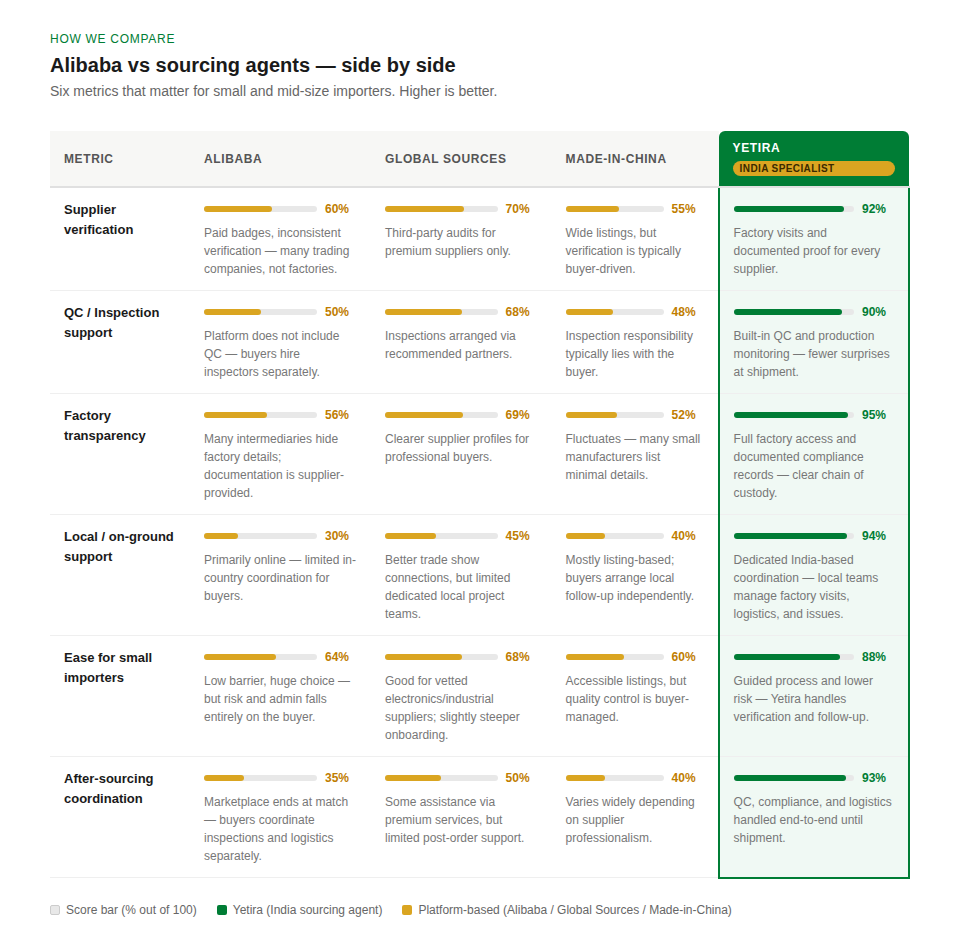
Verification is buyer-driven. A “Gold Supplier” badge doesn’t mean what most people assume. Many listings are from trading companies, not factories. The QC process, if any, is something you arrange separately, often through third parties who charge per inspection, per visit, per shipment.
For brands placing large, regular orders with dedicated sourcing teams, this is manageable. For smaller importers placing $10,000–$100,000 orders who can’t fly to Guangzhou every quarter, it’s a genuine operational risk.
What a sourcing agent actually does differently
A sourcing agent sits between you and the factory. Their job is to handle the things the platform can’t: verifying that the manufacturer is real and capable, managing communication in-language, running QC before goods leave the warehouse, chasing timelines, and being accountable if something goes wrong.
This matters most in two situations:
- When you’re new to a market. India, for example, has deep manufacturing capability in textiles, home goods, handicrafts, and natural-fibre products — but it’s not as well-catalogued online as China. Finding the right factories, especially outside the big trade hubs, often requires someone on the ground.
- When consistency matters more than discovery. Once you’ve found a product category you want to build on, a sourcing agent becomes more valuable than a directory. They manage the relationship so you don’t have to restart from scratch each time.
The trade-offs are real
A sourcing agent isn’t free, and they’re not right for every situation. If you’re placing a one-time order for a commodity product where quality variance is low-risk, Alibaba probably makes sense. The agent model adds more value when you’re dealing with custom specifications, natural materials, or categories where factory-to-factory quality differences are significant.
You’re also trusting someone else to have eyes on your supply chain. Picking a sourcing partner requires due diligence – you’re not just picking a platform, you’re picking a team.
India-specific sourcing is worth understanding separately
Most of the “alternatives to Alibaba” conversation focuses on China, because that’s where the platform is strongest. India is a different market, and it’s genuinely underserved by discovery platforms.
The home textiles cluster in Karur, the knitwear hub in Tirupur, the handicrafts regions across Rajasthan and Uttar Pradesh – these manufacturing ecosystems don’t map neatly onto an Alibaba-style listing model. Many of the best manufacturers don’t maintain active digital profiles.
Relationships and referrals still drive a lot of the business.
This is where a specialist sourcing agency operating in India adds real value – not because the platform model is bad, but because the underlying market structure is different.
The bottom line
Alibaba is a tool, not a solution. It’s useful at a specific stage of the sourcing journey, and less useful once you need accountability, consistency, or on-the-ground support in markets it doesn’t cover well.
If you’re sourcing from India or thinking about it – the directory model has real limits. The manufacturers exist, the quality is there, but getting to the right ones and managing production from a distance takes more than a search bar.