
How to Source Low MOQ Products from India (Without Getting Burned)
If you run an independent gift shop, homewares boutique, or lifestyle store, you already know the frustration. You discover a beautiful hand-block printed bed runner, a stone-washed cotton throw, or a hand-woven basket tray from India, and then you see the minimum order quantity. Five hundred pieces. A full container. A number designed for supermarkets, not for a curated shop of 800 square feet.
This is one of the most common barriers stopping small retailers from accessing one of the world’s great manufacturing nations. And yet, the problem is almost entirely solvable, if you work with the right people.
Why Small Retailers Need Low MOQ
The economics of independent retail are unforgiving. Your cash is tied up in stock. Your storage is finite. Your customers expect freshness and range, not a single SKU in ten colourways stacked floor to ceiling. Committing to 500 units of anything is a gamble most small stores simply cannot afford.
Low MOQ sourcing isn’t a luxury request. It’s a structural necessity. You need to test new products before committing to volume, maintain a curated and constantly refreshed range, manage cash flow without locking up working capital in slow-moving stock, and build supplier relationships gradually, based on proven sell-through, not blind faith.
The irony is that Indian manufacturers are uniquely capable of producing exactly what discerning independent retailers want: handmade, artisanal, ethically produced, beautifully designed. But their pricing models and MOQs are built for volume buyers. The small retailer falls through the gap.
Why Indian Factories Set High MOQs (And Why It’s Not Personal)
To solve a problem, you need to understand it. Indian manufacturers set high MOQs for entirely logical reasons. Setting up a loom, dyeing a batch of yarn, printing a fabric pattern- all of this has a fixed cost. Spreading that fixed cost across 500 units makes it viable. Across 50 units, it often doesn’t.
There’s also a relationship dynamic at play. A factory owner managing dozens of buyers allocates their capacity, their attention, and their best workers to buyers they trust, buyers who have ordered before, who pay reliably, and who represent predictable volume. A new buyer asking for 30 pieces of something is, from the factory’s perspective, an unknown quantity with an uncertain future.
This isn’t obstruction. It’s just how manufacturing economics work. And it means that simply emailing factories directly, however politely – rarely solves the MOQ problem for a small retailer.
The Real Solution: Work with Someone Who Already Has the Relationships
Here is the shift in thinking that unlocks everything: the MOQ problem isn’t primarily a price problem. It’s a trust and relationship problem.
When a sourcing partner based in the manufacturing cluster approaches a factory on your behalf, the conversation is completely different. The factory already knows this partner. They’ve produced for them before. They know orders are real, specifications are clear, and payment is dependable. The risk calculus changes, and with it, the willingness to produce smaller quantities.
A buying partner physically based in the manufacturing region can walk into a factory, inspect production in real time, and resolve issues before a shipment leaves. This physical presence is something no import agent sitting in London or Sydney can replicate. It’s also the foundation of the long-term supplier relationships that make low MOQ possible.
A good sourcing partner doesn’t just pass on your purchase order. They are a known entity to the factory. Their volume, aggregated across multiple retail clients, gives them leverage. And because they’re not placing a single small order, but consolidating demand across buyers, the factory can run a commercially viable production batch while each individual retailer receives only what they need.
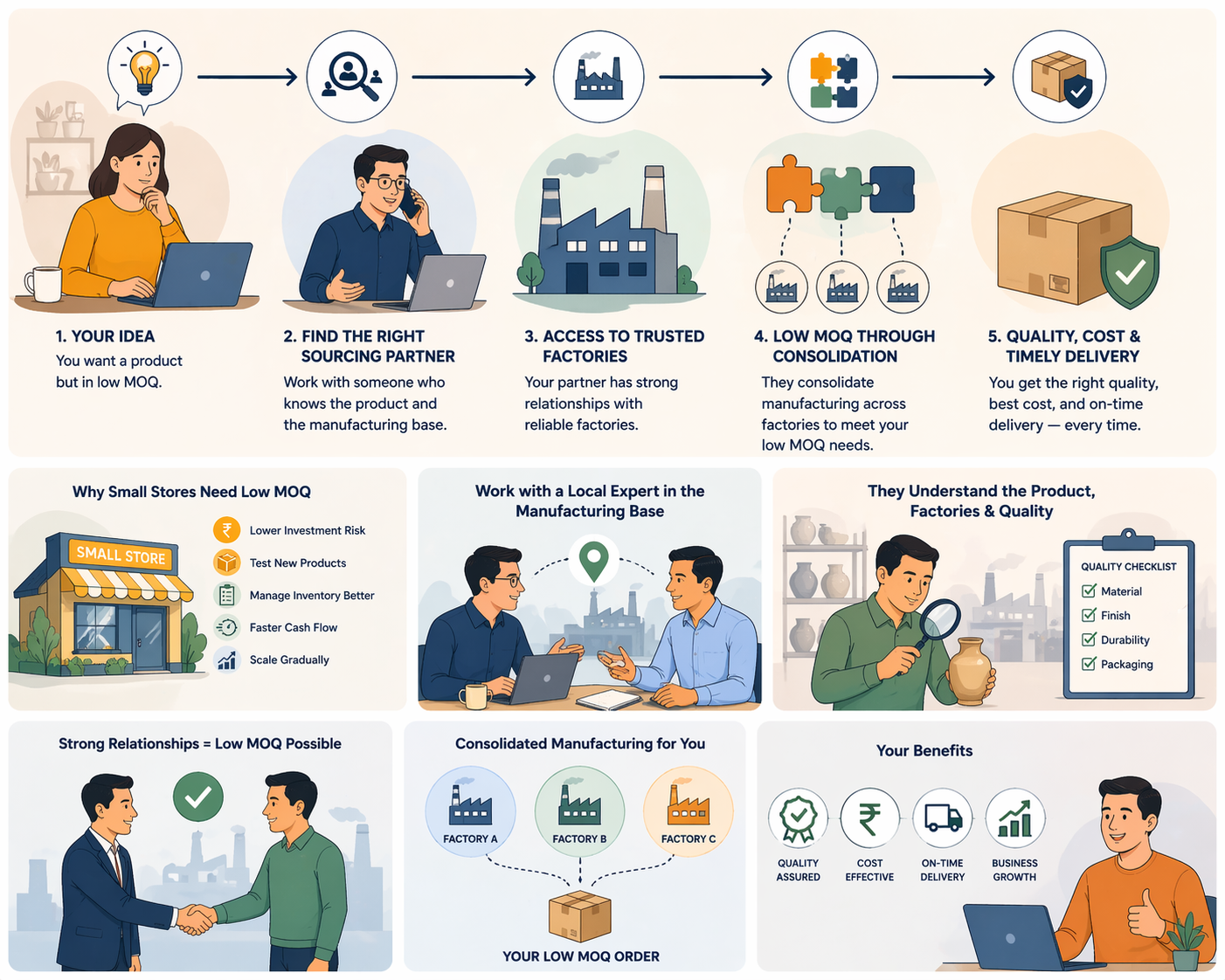
Demand Consolidation: How the MOQ Problem Actually Gets Solved
This is the mechanism worth understanding clearly. Imagine three independent retailers, one in Bristol, one in Melbourne, one in Toronto, each wanting 80 units of the same stonewashed cotton throw. Individually, none of them meets the factory’s 200-unit MOQ. Together, they do.
A sourcing partner that works across multiple markets can aggregate this demand. The factory sees a viable production run. Each retailer gets their 80 pieces. The MOQ barrier disappears, not through negotiation alone, but through structural consolidation.
This is why the sourcing partner model exists. It’s not just sourcing. It’s demand aggregation, relationship management, and logistics coordination, all handled by someone who lives and works inside the manufacturing ecosystem.
Product Expertise Changes Everything
There’s another dimension that rarely gets discussed: knowing what questions to ask.
When a retailer sources directly, even if they manage to place a small order, they often lack the product knowledge to specify correctly. What thread count is appropriate for this end use? Is this dye process compliant with the importing country’s regulations? Is this construction suitable for the price point?
Getting these things wrong costs money. It means samples that don’t convert, orders that arrive with unexpected quality issues, or products that simply don’t sell because the specification wasn’t right for the market.
A buying partner with deep category expertise, someone who has worked in the product for years, who knows the factories, the raw materials, and the end markets, eliminates most of these risks before they happen. They manage sampling rigorously so what you approve is what you receive. They conduct pre-shipment inspections. They guide specifications so they’re commercially right for your customer. They don’t just source. They advise.
What to Look For in an India-Based Buying Partner
Not every sourcing agent offers the same thing. Look for physical presence in the manufacturing cluster, not a remote agent, but someone on the ground. Look for established factory relationships built over years of repeat business, not a directory and a phone. Look for category specialization, deep knowledge of the specific product, not a generalist who sources everything from garments to electronics. And look for a transparent commercial model; sourcing partners typically earn through the supply chain, not through upfront fees charged to you.
The opportunity in Indian manufacturing is real, and it’s not only for large importers. With the right partner, someone inside the manufacturing base, with category expertise and supplier relationships built over years, the MOQ barriers that seem insurmountable when you approach factories directly become entirely manageable.
For independent retailers who want beautiful, ethically made, competitively priced product from India without minimum order commitments designed for supermarket buyers, the answer isn’t to keep emailing factories directly. It’s to find the right person already standing inside the door.
Yetira is a Karur-based sourcing partner with 20 years in Indian home textiles. We work with independent retailers across the UK, Australia, and North America, no upfront fees, no minimum commitment to start. Get in touch at yetira.com