Why Small UK Retailers Struggle with Private Label Gifts and Homeware
If you run an independent gift, home décor, or lifestyle store in the UK, you’ve likely felt it, everyone seems to be selling the same products. The same wholesalers, the same catalogues, the same designs. Standing out is harder than ever.
That’s why private labelling has become so attractive. It gives you control over your brand, better margins, and a chance to offer something unique. But despite this demand, many small retailers still struggle to make private label work.
At first glance, the solution seems simple. Instead of expensive woven labels with high minimum order quantities, why not just use printed labels or stickers? They’re cheaper and flexible. But the reality is more complex.
The challenge isn’t just the label, it’s the entire system around it.
Most UK suppliers are built for efficiency, not customisation. Their model is simple: import products, store them, and sell them quickly. Private labelling disrupts this flow. Suddenly, they need to customise each order, manage separate packaging, and handle small batch requests. This adds time, cost, and operational complexity.
Even small changes like adding a printed label require labour, and in the UK, labour costs are high. For small orders, this quickly eats into margins.
There’s also the risk factor. Customised products are harder to resell if a retailer doesn’t reorder. So suppliers often prefer selling standard products to many stores rather than tailoring products for a few.
But here’s the key insight: retailers don’t just want a logo on a product. They want something that feels like their own, unique designs, thoughtful packaging, and a story behind the product.
This is where sourcing models outside the UK, especially from India, are quietly solving the problem.
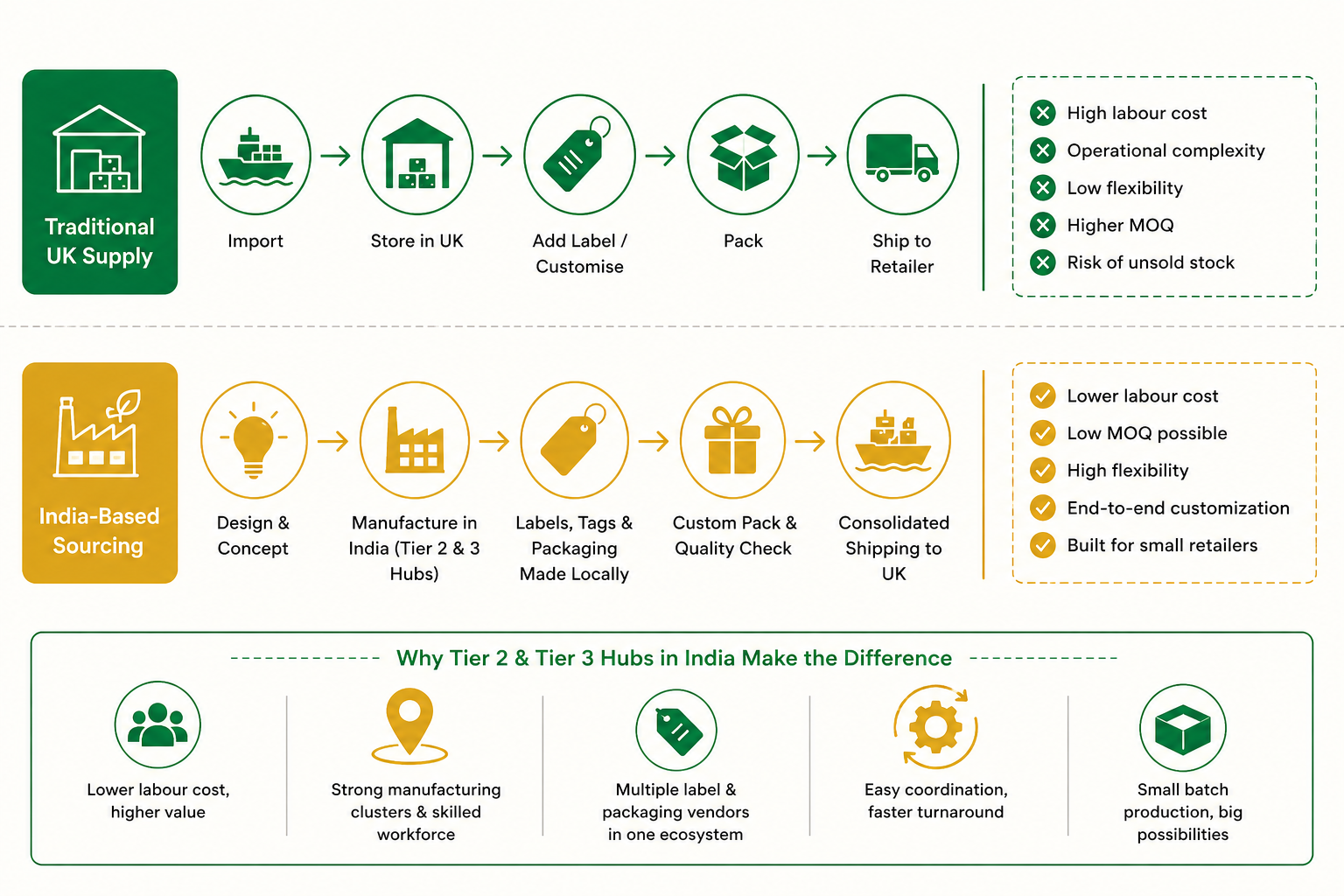
This integrated approach removes the frictionUK suppliers face and gives small retailers what they actually need: differentiated products without high risk.
When production is closer to the manufacturing base, private labelling becomes far more efficient. In India, particularly across Tier 2 and Tier 3 manufacturing hubs (for example, clusters like Karur for home textiles), there is already a strong ecosystem of small-scale producers, label makers, and packaging vendors working in close proximity.
This allows:
- Lower labour costs for customization
- Easy coordination between product, label, and packaging
- Flexibility to handle small batch production
Instead of adding labels at the end, products can be developed with branding, tags, and packaging built in from the start. Multiple vendors- labels, tags, stitching units, and packers, can work together seamlessly, making even low MOQ private labelling viable and cost-effective.
Instead of adapting products at the end, the future lies in building them with branding in mind from the start. And that’s exactly where new sourcing models, like Yetira, are stepping in to bridge the gap.
Because today, it’s not just about selling products. It’s about building your brand.