What Small Retailers Need to Know About MOQ Pricing
There’s a conversation happening quietly across sourcing emails and trade show corridors. A small UK retailer or emerging e-commerce brand approaches an Indian manufacturer with a modest order, maybe 200 cotton throws or 500 napkin sets. The quantities are small. The price expectation? Identical to what a major chain pays for 10,000 pieces.
It’s an awkward ask. And it’s becoming increasingly common.
The Math Doesn’t Change Because You’re Growing
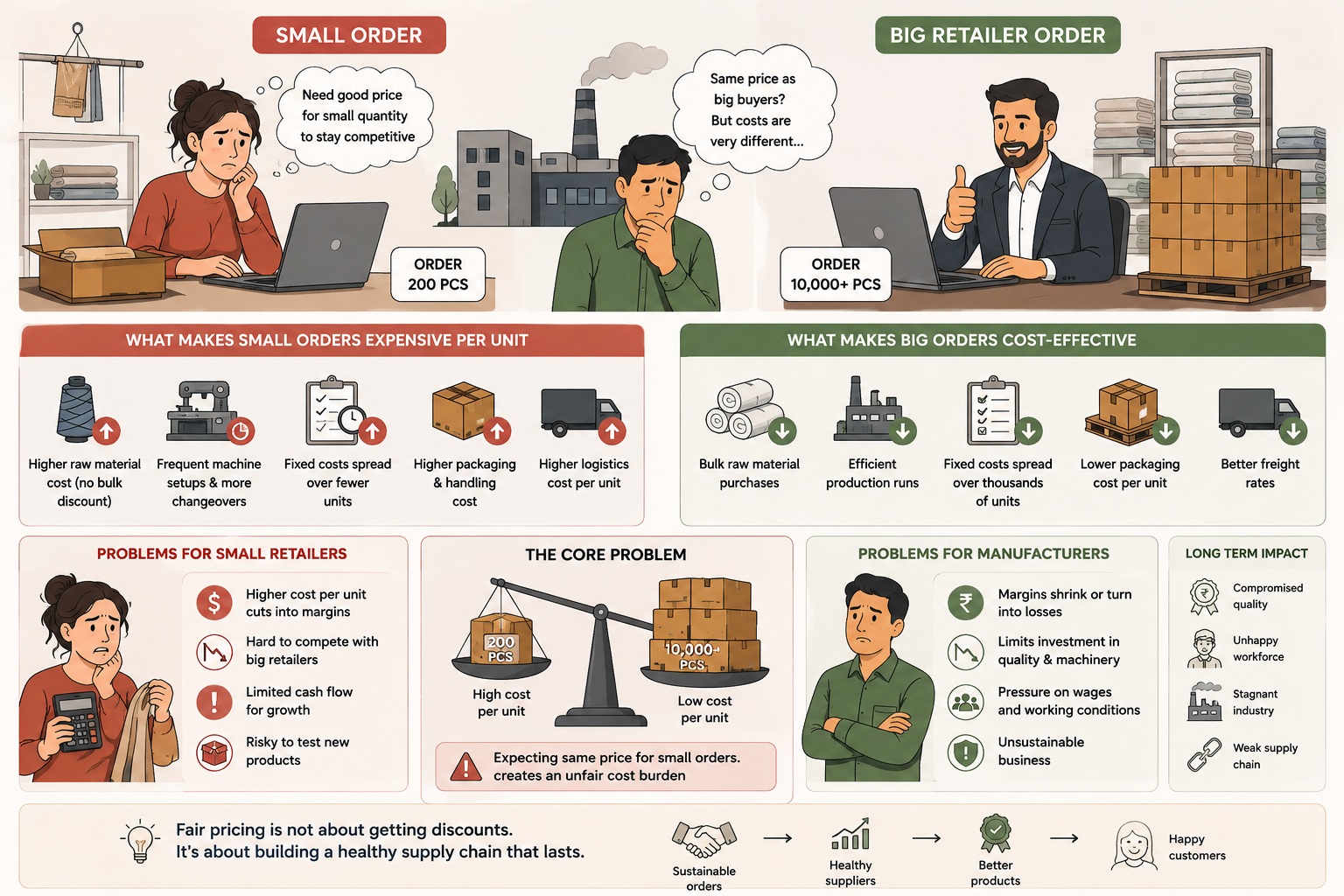
Volume pricing exists for a reason. When a manufacturer produces 10,000 pieces, fixed costs such as sampling, machine setup, raw material procurement, and quality inspection spread across thousands of units. The economics work.
At 200 pieces, those same costs don’t shrink. Raw materials are bought at spot rates. Machine changeovers eat into production hours. A manufacturer offering large-order pricing on a small order isn’t being generous, they’re subsidising your business model with their own margin.
The Margin Asymmetry Nobody Talks About
Here’s what rarely gets said plainly: when a small retailer or D2C brand builds their pricing, they lock in their margin first. Overheads, platform fees, and marketing are all protected. What remains is then handed to a manufacturer 7,000 miles away, with the expectation that they’ll absorb whatever gap is left.
The retailer carries the brand risk. The manufacturer carries the production risk, raw material volatility, quality liability, and now, a margin that doesn’t reflect the actual cost of a small run.
That’s not a partnership. That’s a transfer of risk with a smile.
What It Means for Ethical Sourcing
A manufacturer under chronic margin pressure cuts somewhere, raw material quality, worker wages, or the reinvestment that would have gone into better equipment or cleaner processes. The conversation about ethical sourcing can’t stop at audit certificates. It has to extend to whether the commercial terms allow a supplier to actually operate sustainably.
A More Honest Starting Point
At Yetira, we work with manufacturers across Karur and South India who produce exceptional home textiles. Small orders are welcome, but we structure them so the economics work for everyone in the chain, not just the brand with the Instagram presence and the planned margin.
If you’re building something real, let’s have the honest conversation first.
Yetira operates as a cluster-based sourcing and manufacturing ecosystem in Karur, Tamil Nadu, enabling global brands to access specialised Indian home textile manufacturers with greater flexibility, transparency, and production support.